

В этой статье вы узнаете:
Prostate cancer treatment in Germany is based on precise diagnosis, structured staging, and multidisciplinary review to help choose an appropriate medical strategy.
PSA rising or an MRI report causing concern?
German urologists assess PSA trends, PSA density, ultrasound, mpMRI with PI-RADS, biopsy pathology, and staging imaging to outline a medically sound treatment strategy!.
Get a treatment planThe doctor or coordinator will answer within 24-48 hours.
Prostate cancer treatment in Germany: what patients need to understand first
Prostate cancer treatment in Germany follows a stepwise medical pathway that begins with accurate diagnosis and staging. This approach helps distinguish slow-growing disease from forms that require active treatment. Many patients arrive with partial information such as a single PSA value or an MRI report, yet treatment decisions depend on how all findings fit together rather than on any isolated result.
German urology and oncology standards emphasise risk stratification before treatment selection. The aim is to avoid overtreatment when monitoring is reasonable and to identify situations where timely intervention improves long-term cancer control.
Who this guide is for
This guide is written for patients who are considering prostate cancer treatment in Germany or who want a second medical opinion based on German clinical standards. Typical situations include rising PSA levels, suspicious findings on mpMRI, a confirmed prostate biopsy, uncertainty about treatment choice, or concern about recurrence after previous therapy.
Understanding prostate cancer in plain language
The prostate is a small gland located below the bladder. Prostate cancer develops when cells in the gland begin to grow in an uncontrolled way. In many men, prostate cancer grows slowly and may never cause symptoms. In others, it can progress, spread beyond the prostate, and require treatment.
Because growth behaviour varies widely, doctors rely on structured diagnostic tools rather than symptoms alone. Early prostate cancer often causes no symptoms. Urinary difficulties, pain, or weight loss are more commonly associated with advanced disease.
Diagnosis pathway for prostate cancer treatment in Germany
Before prostate cancer treatment in Germany is discussed, doctors usually follow a defined diagnostic pathway. Each step answers a specific medical question and reduces uncertainty.
PSA testing and PSA density
PSA is a protein produced by prostate tissue. PSA levels may rise due to benign enlargement, inflammation, or cancer. German specialists interpret PSA in context, including prostate volume and PSA density. A steadily rising PSA over time often provides more information than a single measurement.
Multiparametric MRI and PI-RADS
Multiparametric MRI combines different imaging sequences to assess prostate tissue. Radiologists use the PI-RADS system to describe how suspicious a lesion appears. A higher PI-RADS score suggests a greater likelihood of clinically relevant cancer, but it does not replace biopsy.
| PI-RADS score | Typical interpretation | Common next step |
|---|---|---|
| 1–2 | Low suspicion | Clinical follow-up, PSA monitoring |
| 3 | Equivocal | Individualised decision based on PSA density and risk factors |
| 4–5 | High suspicion | MRI-targeted biopsy usually considered |
Prostate biopsy and pathology
A biopsy confirms the diagnosis by analysing tissue samples under a microscope. German centres often combine systematic sampling with MRI-targeted biopsy when a suspicious lesion is present. Pathology reports include the Gleason score and Grade Group, which describe how aggressive the cancer cells appear.
Relevant background material: prostate biopsy overview and MRI-targeted fusion biopsy.
Staging imaging and PSMA PET/CT
Staging determines whether cancer is confined to the prostate or has spread. Imaging may include CT, MRI, bone assessment, and, in selected cases, PSMA PET/CT. PSMA PET/CT can detect small metastases and is often considered in higher-risk disease or biochemical recurrence.
Further reading: PSMA PET/CT in prostate cancer.
Staging and risk classification explained
For prostate cancer treatment in Germany, staging and risk classification guide every major decision. Doctors commonly use the TNM system together with PSA and Grade Group.
TNM staging in simple terms
The TNM system describes tumour extent within the prostate (T), lymph node involvement (N), and distant spread (M). Early stages indicate cancer confined to the prostate, while higher stages suggest local extension or metastases.
Grade Group and Gleason score
The Gleason score reflects how abnormal cancer cells look. Grade Groups range from 1 to 5, with higher groups indicating more aggressive behaviour. This information is central to deciding whether monitoring or active treatment is appropriate.
Risk groups and their meaning
Risk groups combine PSA, Grade Group, and staging information. They help balance cancer control against potential side effects of treatment.
| Risk group | Typical disease features | General management approach |
|---|---|---|
| Low risk | Low PSA, Grade Group 1 | Active surveillance often considered |
| Intermediate risk | Moderate PSA or Grade Group 2–3 | Curative treatment usually discussed |
| High risk | High PSA, Grade Group 4–5 | Combined local and systemic strategies |
Indications and limitations before treatment choice
Before selecting prostate cancer treatment in Germany, doctors assess whether a method is medically suitable. Factors include tumour extent, prostate size, urinary symptoms, prior treatments, and general health.
- Surgery may be limited by advanced local spread or severe comorbidities.
- Radiotherapy planning considers prostate volume and baseline urinary function.
- Focal therapies require clearly localised disease on MRI and biopsy mapping.
- Advanced disease often requires systemic treatment planning.
Why complete staging is essential before treatment
Starting treatment without full staging can lead to suboptimal outcomes. In German practice, multidisciplinary tumour boards often review complex cases. This process integrates urology, radiology, pathology, and oncology expertise to confirm stage and align treatment intensity with disease behaviour.
Why patients consider prostate cancer treatment in Germany
Germany applies established European standards in urology and oncology. Patients often seek access to experienced imaging, structured pathology review, and coordinated decision-making. For guideline context, see EAU prostate cancer guidelines and ESMO recommendations.
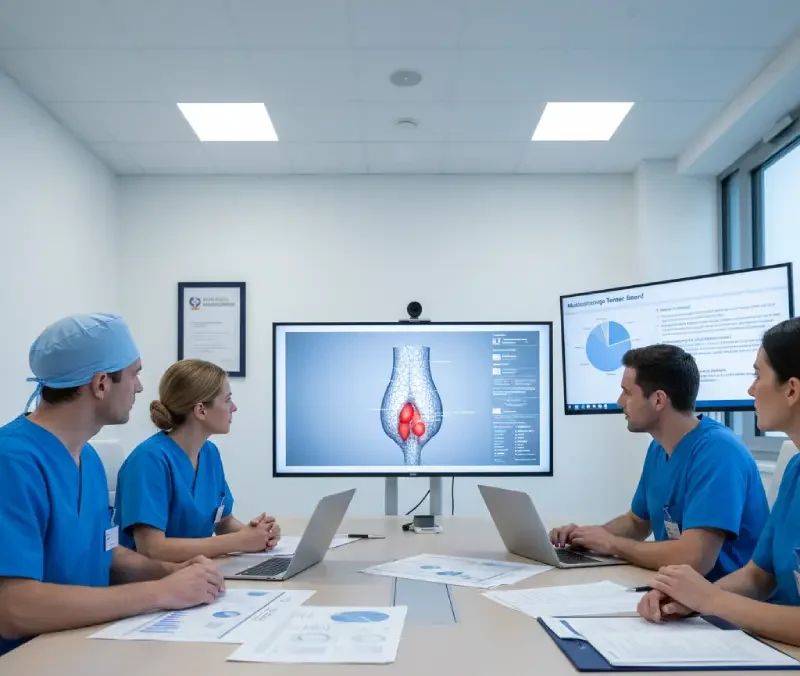
After staging is complete, prostate cancer treatment in Germany focuses on selecting a method that balances cancer control with long-term quality of life.
Already diagnosed and unsure which treatment fits your stage?
German tumour boards review staging, biopsy, and imaging to compare surgery, radiotherapy, focal therapy, or systemic options and outline a clear medical plan!.
Get a treatment planThe doctor or coordinator will answer within 24-48 hours.
Treatment options for prostate cancer treatment in Germany
Once diagnosis and risk classification are complete, doctors select treatment based on stage, Grade Group, life expectancy, existing urinary or sexual function, and patient priorities. German standards emphasise informed choice rather than a single default solution.
Active surveillance
Active surveillance is a structured monitoring strategy for selected low-risk cancers. It includes regular PSA testing, clinical review, repeat imaging, and biopsy when indicated. The aim is to avoid immediate treatment while maintaining the option for curative therapy if risk features change.
This approach is not passive. German protocols define follow-up intervals and criteria that trigger treatment, such as Grade Group progression or increasing tumour volume.
Radical prostatectomy
Radical prostatectomy removes the prostate gland and is commonly used for localised disease with curative intent. The operation may be performed using open, laparoscopic, or robotic techniques, depending on centre experience and anatomy.
Key medical considerations include the feasibility of nerve-sparing, lymph node evaluation, and baseline urinary and sexual function. Recovery varies between individuals, and early side effects do not necessarily reflect long-term outcomes.
Radiation therapy
Radiation therapy delivers targeted radiation to prostate tissue. Techniques such as IMRT or VMAT allow dose shaping to reduce exposure to surrounding organs. Some patients may be candidates for brachytherapy, which places radiation sources directly into the prostate.
Radiation may be combined with hormone therapy in intermediate- or high-risk disease. Treatment schedules and side-effect profiles are discussed in advance.
Related information: radiation therapy for prostate cancer.
Focal therapy approaches
Focal therapy targets only the tumour area rather than the entire prostate. High-intensity focused ultrasound (HIFU) is one option. It may be considered for carefully selected patients with localised disease that is well defined on MRI and biopsy mapping.
Because evidence and long-term data differ between techniques, German specialists evaluate focal therapy eligibility cautiously.
Related information: HIFU focal therapy.
Hormone therapy and advanced disease management
Hormone therapy, also known as androgen deprivation therapy, reduces testosterone stimulation of prostate cancer cells. It is used alongside radiotherapy in certain risk groups and as a backbone of treatment for advanced disease.
In metastatic or recurrent disease, treatment planning may include modern imaging such as PSMA PET/CT and additional systemic therapies. Selection depends on disease extent, prior treatment response, and general health.
Related information: PSMA-based treatment options.
Comparing treatment approaches
Each treatment option has different implications for recovery and side effects. Doctors focus on aligning medical benefit with patient priorities.
| Treatment option | Main goal | Key considerations |
|---|---|---|
| Active surveillance | Monitoring | Requires adherence to follow-up and acceptance of uncertainty |
| Radical prostatectomy | Curative | Surgical risks, continence and erectile function recovery |
| Radiation therapy | Curative | Urinary and bowel effects, treatment duration |
| Focal therapy | Targeted control | Strict selection, limited long-term data |
| Systemic therapy | Disease control | Used in advanced or metastatic settings |
Recovery and rehabilitation
Recovery depends on treatment type and individual factors. German centres typically provide structured follow-up plans.
- After surgery, urinary control often improves gradually with pelvic floor rehabilitation.
- Erectile function recovery depends on baseline function, nerve preservation, age, and rehabilitation strategies.
- After radiotherapy, urinary irritation or bowel sensitivity may occur and usually require symptom-based management.
- Long-term follow-up focuses on PSA monitoring and quality-of-life assessment.
Prognosis and follow-up
Prognosis in prostate cancer is strongly influenced by stage, Grade Group, and response to initial treatment. Many men with localised disease have long-term cancer control.
After treatment, PSA levels are monitored regularly. A rising PSA after curative therapy is called biochemical recurrence. Further evaluation may include imaging and discussion of additional treatment options.
Realistic clinical scenarios
Rising PSA with PI-RADS 4 lesion
In this situation, MRI-targeted biopsy is often recommended to confirm diagnosis and define Grade Group before any treatment decision.
Intermediate-risk localised disease
Both surgery and radiotherapy may be discussed. The choice depends on anatomy, baseline urinary and sexual function, and personal preferences regarding side effects and recovery.
PSA increase after initial treatment
PSMA PET/CT may be considered to localise recurrence and guide further management.
Cost of prostate cancer treatment in Germany
Costs depend on diagnostic completeness, selected treatment, hospital setting, and length of stay. Reliable estimates require review of PSA history, mpMRI reports, biopsy pathology, and staging imaging.
| Service or stage | Typical cost range (€) | What is usually included |
|---|---|---|
| mpMRI of the prostate | 700–1,200 | 3 Tesla imaging and PI-RADS reporting |
| Prostate biopsy | 1,500–3,000 | Procedure, pathology analysis, monitoring |
| Radical prostatectomy | 18,000–30,000 | Surgery, hospital stay, standard care |
| Radiation therapy course | 15,000–25,000 | Treatment planning and full schedule |
| Focal therapy (HIFU) | 10,000–20,000 | Targeted ablation and short stay |
What outcomes look like with prostate cancer treatment
When prostate cancer treatment is selected according to stage and risk, long-term outcomes are often favourable. Large European and international datasets show that many men live for years or decades after diagnosis, particularly when prostate cancer treatment is started at a localised stage and follows guideline-based pathways.
| Clinical situation | Observed outcome | What it means for patients |
|---|---|---|
| Localised disease treated with curative intent | >90% | Overall 5-year survival reported in population-based studies after prostate cancer treatment |
| Low-risk cancer on active surveillance | >98% | Prostate cancer–specific survival at 10 years with structured monitoring instead of immediate treatment |
| After surgery or radiation therapy | 70–90% | No biochemical recurrence at 5 years, depending on initial risk group and treatment choice |
| Intermediate-risk prostate cancer treatment | >85% | Long-term cancer control when prostate cancer treatment follows guideline-based strategies |
| Early detection before symptoms | Majority | Prostate cancer treatment can be planned before spread in screened and MRI-evaluated populations |
These figures reflect outcomes from large registries and guideline summaries and describe population trends rather than individual guarantees. Prognosis after prostate cancer treatment depends on stage, Grade Group, response to therapy, and overall health. German clinical practice uses these data to tailor prostate cancer treatment intensity with the aim of effective cancer control and preservation of quality of life.
Why Germany for prostate cancer treatment
Germany follows European Association of Urology and ESMO guidelines, uses multidisciplinary tumour boards, and applies advanced imaging and pathology standards. Patients often seek a second opinion to confirm stage and treatment strategy.
Guideline context: EAU guidelines and ESMO clinical practice recommendations.
How kliniki.de supports treatment planning
kliniki.de assists with medical document review, coordination of expert opinions, and preparation of treatment plans in German centres. Useful documents include PSA history, mpMRI reports, biopsy pathology, and previous treatment summaries.
Need confirmation of stage or treatment choice?
German specialists can review your documents, confirm risk and stage, and outline realistic treatment options based on current standards!.
Get a treatment planThe doctor or coordinator will answer within 24-48 hours.